
June 05, 2026 · Marco Groessler
Why Battery Voltage Matters
Your car battery is the foundation of the vehicle's electrical system.
Without sufficient voltage, your vehicle may experience:
-
Slow engine cranking
-
Hard starting
-
Dim headlights
-
Electronic malfunctions
-
Complete no-start conditions
Fortunately, voltage testing is one of the fastest and easiest ways to evaluate battery condition.
A simple digital multimeter can reveal valuable information about battery health in less than a minute.
However, many vehicle owners misunderstand voltage readings and often replace batteries unnecessarily.
This guide explains what battery voltage means, how to interpret readings correctly, and when action is required.
Understanding How a 12-Volt Battery Works
Despite being called a "12-volt battery," automotive batteries rarely measure exactly 12.0 volts.
A typical lead-acid battery contains six cells.
Each cell produces approximately:
2.1 volts
When fully charged:
6 × 2.1 volts = 12.6 volts
This is why healthy batteries generally read between 12.6V and 12.8V at rest.
As charge decreases, voltage gradually falls.
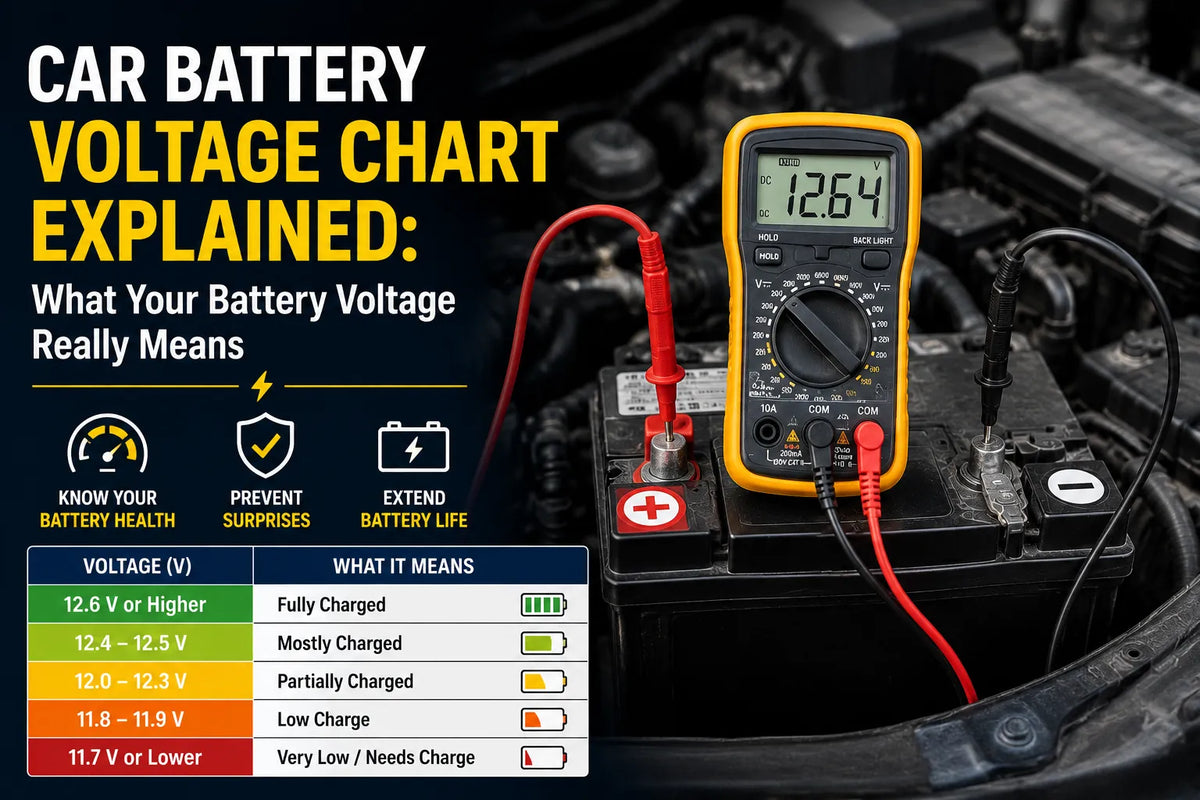
Complete Car Battery Voltage Chart
Engine Off (Resting Voltage)
| Voltage Reading | Battery Condition | Recommended Action |
|---|---|---|
| 12.8V+ | Fully charged | No action required |
| 12.6V–12.7V | Healthy | Normal operation |
| 12.4V–12.5V | Partially charged | Monitor or recharge |
| 12.2V–12.3V | Approximately 50% charged | Recharge soon |
| 12.0V–12.1V | Low charge | Recharge immediately |
| Below 12.0V | Severely discharged | Test and recharge |
| Below 11.8V | Potential battery damage | Diagnostic testing recommended |
| Below 10.5V | Possible failed cell | Replacement likely needed |
This chart applies to most conventional 12V automotive batteries.
What Voltage Should a Healthy Battery Have?
For most vehicles:
Excellent Condition
12.7V–12.8V
Good Condition
12.6V
Acceptable Condition
12.4V–12.5V
Needs Attention
Below 12.3V
Many drivers don't realize that a battery can lose significant starting power before it becomes completely dead.
Waiting until the vehicle won't start often means you've ignored warning signs for weeks or months.
Battery Voltage with the Engine Running
Testing voltage while the engine runs helps evaluate alternator performance.
Expected Charging Voltage
| Reading | Charging System Status |
|---|---|
| 13.7V–14.7V | Normal |
| Above 15V | Overcharging |
| Below 13V | Undercharging |
| Near battery voltage | Charging system problem |
A healthy alternator should increase system voltage significantly above resting battery voltage.
If charging voltage remains low, the battery may not be receiving sufficient charge during driving.
How to Check Battery Voltage
Testing battery voltage requires only a digital multimeter.
Step 1
Turn off:
-
Engine
-
Headlights
-
Radio
-
Accessories
Allow the vehicle to sit for at least 30 minutes.
This removes surface charge and improves accuracy.
Step 2
Set the multimeter to:
DC Voltage (20V range)
Step 3
Connect:
-
Red probe to positive terminal
-
Black probe to negative terminal
Step 4
Read the display.
Compare the reading against the voltage chart above.
The entire process takes less than two minutes.
Why Voltage Sometimes Looks Normal When the Battery Is Bad
One of the biggest diagnostic mistakes is assuming voltage alone determines battery health.
A battery can show:
12.6 volts
and still fail to start the vehicle.
Why?
Because voltage only measures electrical pressure.
It does not measure the battery's ability to deliver current under load.
This is why professional workshops often perform:
-
Load testing
-
Conductance testing
-
CCA testing
A battery may appear healthy until a heavy load is applied.
What Is CCA and Why Does It Matter?
CCA stands for:
Cold Cranking Amps
This measurement indicates how much current a battery can deliver during cold weather starting.
As batteries age:
-
Voltage may remain acceptable
-
CCA declines
This explains why older batteries often struggle during winter mornings even when voltage appears normal.
Low CCA is one of the strongest indicators that replacement is approaching.
Common Voltage Readings and Their Meaning
Reading: 12.7V
Excellent condition.
Battery is fully charged and operating normally.
Reading: 12.5V
Battery is slightly discharged.
Not immediately concerning but worth monitoring.
Reading: 12.2V
Battery is approximately half charged.
Charging is recommended.
Repeated operation at this level can shorten battery life.
Reading: 12.0V
Battery is significantly discharged.
Vehicle reliability may be compromised.
Recharge immediately.
Reading: 11.8V or Lower
Battery may have:
-
Sulfation
-
Internal damage
-
Charging system problems
Further testing is required.
What Causes Low Battery Voltage?
Several factors can reduce battery voltage.
Battery Age
Most automotive batteries last between:
3–5 years
Performance declines gradually over time.
Short Driving Trips
Frequent short journeys prevent full charging.
The battery loses more energy during starting than it regains during driving.
Extreme Temperatures
Heat accelerates internal battery degradation.
Cold weather reduces available cranking power.
Parasitic Drain
Electrical devices may continue drawing power when the vehicle is parked.
Common examples include:
-
Alarm systems
-
Dash cameras
-
Interior electronics
-
Faulty modules
Alternator Problems
A weak alternator cannot fully recharge the battery.
This leads to chronic low-voltage conditions.
Voltage Testing vs Load Testing
Many vehicle owners wonder which test is better.
The answer is both.
| Test | Purpose |
|---|---|
| Voltage Test | Measures state of charge |
| Load Test | Measures battery performance under demand |
| CCA Test | Measures starting capability |
| Alternator Test | Evaluates charging system |
Professional diagnosis typically combines multiple tests.
Troubleshooting Battery Voltage Problems
Voltage Drops Overnight
Possible causes:
-
Parasitic drain
-
Internal battery failure
-
Poor charging habits
Investigation is recommended.
Voltage Never Exceeds 12.3V
Possible causes:
-
Battery sulfation
-
Weak charger
-
Failing battery
Try charging fully and retesting.
Engine Running Voltage Below 13V
Possible causes:
-
Alternator failure
-
Belt issues
-
Wiring faults
Charging system inspection is required.
Battery Keeps Going Flat
Possible causes:
-
Aging battery
-
Charging system problem
-
Electrical drain
Testing both the battery and alternator is essential.
Battery Maintenance Tips
Keeping voltage healthy extends battery life.
Keep Terminals Clean
Corrosion increases resistance.
Clean terminals regularly.
Use a Smart Battery Charger
Smart chargers maintain optimal charge levels and prevent overcharging.
Test Voltage Every Few Months
Regular testing helps identify problems before breakdowns occur.
Avoid Deep Discharges
Repeatedly allowing voltage to fall below 12 volts accelerates battery wear.
Use a Battery Maintainer During Storage
Vehicles that sit for extended periods benefit from maintenance charging.
When Should You Replace Your Battery?
Replacement is often the best option when:
-
Battery is over five years old
-
Voltage falls rapidly after charging
-
Battery fails load testing
-
Vehicle requires frequent jump starts
-
Starting performance continues declining
Replacing a failing battery proactively can prevent inconvenient breakdowns.
Conclusion
Understanding battery voltage is one of the easiest ways to monitor vehicle health.
A healthy battery should typically measure between 12.6V and 12.8V at rest and between 13.7V and 14.7V while the engine is running.
Regular voltage testing, proper charging, and routine maintenance help maximize battery life and reduce the likelihood of unexpected failures.
For the most accurate diagnosis, combine voltage testing with load testing and charging system inspection.
A few minutes of testing today can save hours of frustration later.
Frequently Asked Questions
What voltage is too low for a car battery?
Generally, readings below 12.0 volts indicate a significantly discharged battery that should be charged and tested.
Is 12.4 volts okay for a car battery?
Yes. However, it indicates the battery is not fully charged.
What should battery voltage be while driving?
Most vehicles should show between 13.7V and 14.7V with the engine running.
Can a battery show good voltage and still be bad?
Yes. Voltage alone does not measure battery performance under load.
How often should battery voltage be checked?
Testing every two to three months is a good preventative maintenance practice.