
June 05, 2026 · Marco Groessler
Why Car Batteries Go Flat
A dead battery is one of the most common causes of vehicle breakdowns. Understanding why a battery becomes discharged helps prevent future problems.
Common causes include:
- Leaving lights on
- Short driving trips
- Long periods without use
- Extreme temperatures
- Faulty alternators
- Parasitic electrical drains
- Aging batteries
If your battery repeatedly goes flat, charging alone may not solve the underlying issue.
Tools You Need
Before starting, gather the following equipment:
- Smart battery charger
- Safety glasses
- Protective gloves
- Digital multimeter
- Battery terminal cleaning brush
- Clean cloth
For workshop environments, a professional battery tester can provide additional diagnostic information.
Choosing the Right Battery Charger
Not all chargers are designed for every battery type.
| Charger Type | Best For | Advantages |
|---|---|---|
| Smart Charger | Everyday use | Automatic charging and maintenance |
| Trickle Charger | Long-term storage | Maintains battery charge |
| Fast Charger | Emergency charging | Faster charging times |
| Workshop Charger | Professional use | Higher charging capacity |
For most users, a smart charger offers the best balance of safety, battery protection, and convenience.
Step 1: Inspect the Battery
Before connecting a charger, inspect the battery carefully.
Check for:
- Cracks
- Bulging case
- Leaks
- Damaged terminals
- Excessive corrosion
Do not charge a damaged battery. Replace it immediately.
Step 2: Prepare a Safe Charging Area
Battery charging produces gases that can become dangerous if trapped.
Choose a location that is:
- Well ventilated
- Dry
- Free from sparks
- Away from open flames
- Protected from extreme weather
Safety should always be your first priority.
Step 3: Identify Your Battery Type
Modern vehicles use several battery technologies.
Common types include:
Flooded Lead-Acid Batteries
The most common and affordable option.
AGM Batteries
Designed for modern vehicles with start-stop systems and higher electrical demands.
Gel Batteries
Less common in passenger vehicles but found in some specialty applications.
Always select the charging mode that matches your battery type.
Step 4: Connect the Charger Correctly
Follow these steps:
- Turn the charger off.
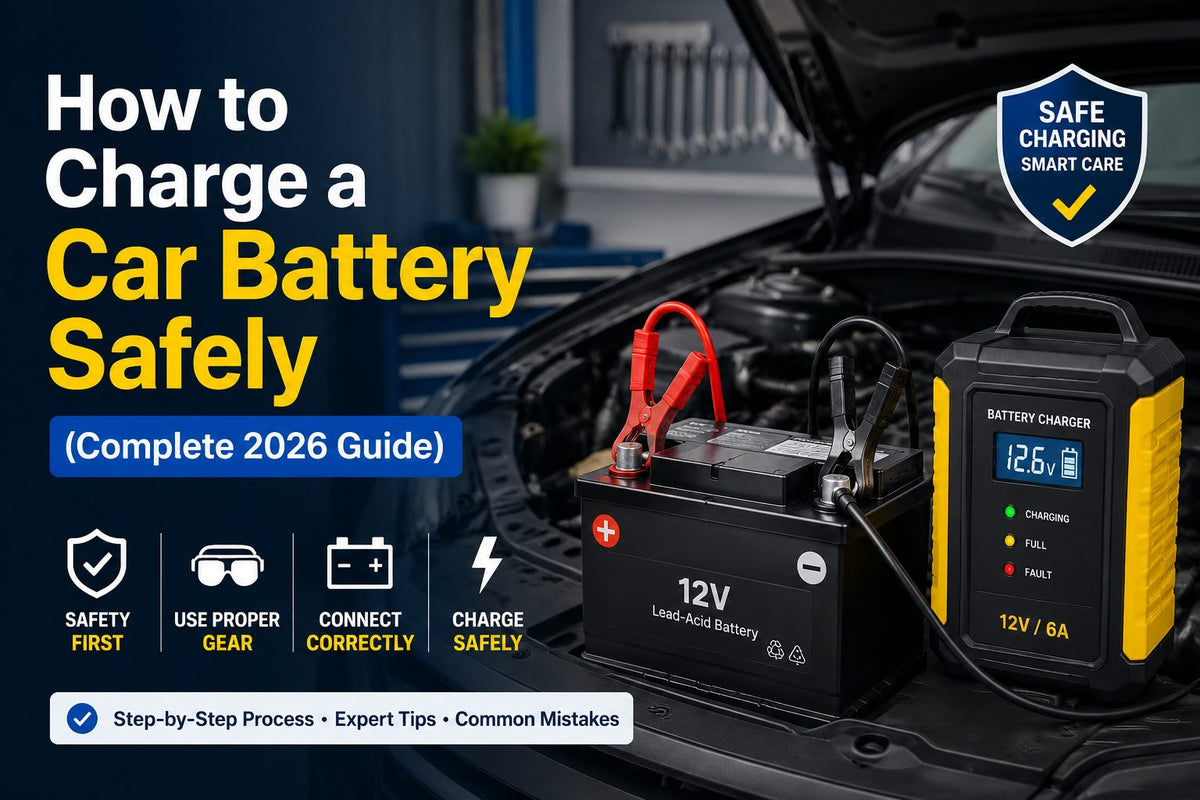
- Connect the red clamp to the positive (+) terminal.
- Connect the black clamp to the negative (-) terminal or approved chassis ground.
- Confirm secure connections.
- Plug in the charger.
Incorrect connections can damage electrical systems or create safety hazards.
Step 5: Select the Correct Charging Mode
Most smart chargers provide multiple charging profiles.
Common settings include:
- Standard 12V battery
- AGM mode
- Maintenance mode
- Reconditioning mode
Choose the setting recommended by the battery manufacturer.
Step 6: Allow the Battery to Charge Fully
Charging time depends on:
- Battery size
- Battery condition
- State of discharge
- Charger output
Typical Charging Times
| Battery Condition | Estimated Time |
|---|---|
| Lightly Discharged | 2–4 Hours |
| Moderately Discharged | 4–8 Hours |
| Deeply Discharged | 8–24 Hours |
Avoid disconnecting the charger before the charging cycle is complete.
Step 7: Disconnect Safely
Once charging is complete:
- Turn off the charger.
- Unplug the charger.
- Remove the negative connection.
- Remove the positive connection.
Store the charger safely after use.
How to Check if Charging Was Successful
Use a digital multimeter to verify battery condition.
Battery Voltage Guide
| Battery Voltage | Battery Condition |
|---|---|
| 12.7V+ | Fully Charged |
| 12.5V–12.6V | Good |
| 12.3V–12.4V | Partially Charged |
| Below 12.2V | Low Charge |
| Below 12.0V | Severely Discharged |
A healthy battery should maintain voltage after charging.
Common Charging Problems
Battery Will Not Charge
Possible causes:
- Internal battery failure
- Sulfation
- Loose charger connections
- Incorrect charging mode
Battery Charges Slowly
Possible causes:
- Small charger output
- Deep discharge
- Cold temperatures
Battery Dies Again Quickly
Possible causes:
- Faulty alternator
- Parasitic drain
- End-of-life battery
Further testing may be required.
Battery Charger vs Jump Starter
Many drivers confuse these products.
| Feature | Battery Charger | Jump Starter |
|---|---|---|
| Charges Battery | Yes | No |
| Starts Vehicle | Sometimes | Yes |
| Long-Term Maintenance | Yes | No |
| Emergency Use | Limited | Excellent |
A jump starter is designed to start a vehicle. A charger restores battery capacity.
Ideally, every garage should have both.
Maintenance Tips to Extend Battery Life
Good maintenance can add years to battery life.
Keep Terminals Clean
Corrosion increases resistance and reduces charging efficiency.
Test Battery Voltage Regularly
Periodic testing helps identify problems early.
Use a Battery Maintainer
Vehicles that sit for long periods benefit from maintenance charging.
Secure Battery Connections
Loose terminals create charging and starting issues.
Avoid Deep Discharges
Repeatedly draining a battery shortens its lifespan.
Safety Considerations
Never overlook battery safety.
Always:
- Wear eye protection
- Wear gloves
- Work in a ventilated area
- Keep sparks away
- Use the correct charger
- Follow manufacturer instructions
Never:
- Charge a frozen battery
- Charge a leaking battery
- Ignore unusual smells or excessive heat
- Reverse charger connections
When It Is Time to Replace the Battery
Charging is not always the answer.
Consider replacement if:
- The battery is more than 4–5 years old
- It repeatedly loses charge
- Voltage drops quickly after charging
- Load testing shows poor performance
Replacing a failing battery is often cheaper than dealing with repeated breakdowns.
Conclusion
Charging a car battery safely is a straightforward process when the correct equipment and procedures are used. A quality smart charger, proper safety precautions, and regular battery maintenance can significantly improve reliability and battery lifespan.
Whether you are a DIY enthusiast, professional mechanic, or workshop owner, understanding proper battery charging techniques helps prevent breakdowns, reduce replacement costs, and keep vehicles operating reliably throughout the year.
FAQ
Can I charge a car battery without removing it from the vehicle?
In many cases yes, provided the charger manufacturer and vehicle manufacturer permit it. Always follow the recommended procedures.
How often should I charge my car battery?
Most regularly driven vehicles do not require routine charging. Vehicles stored for extended periods benefit from a battery maintainer.
Is it safe to leave a smart charger connected overnight?
Most modern smart chargers are designed to automatically switch to maintenance mode when charging is complete.
What is the best charger for a car battery?
A smart charger is generally the safest and most versatile option for modern vehicles.
Can a completely dead battery be recharged?
Sometimes. However, severely discharged batteries may have permanent damage and should be tested before continued use.