
August 24, 2026 · IRONVOLT
Draft: This article is a draft for review. It outlines practical tips for choosing a ratchet and socket set suitable for weekend maintenance, garage work and general DIY.
Why the right ratchet and socket set matters
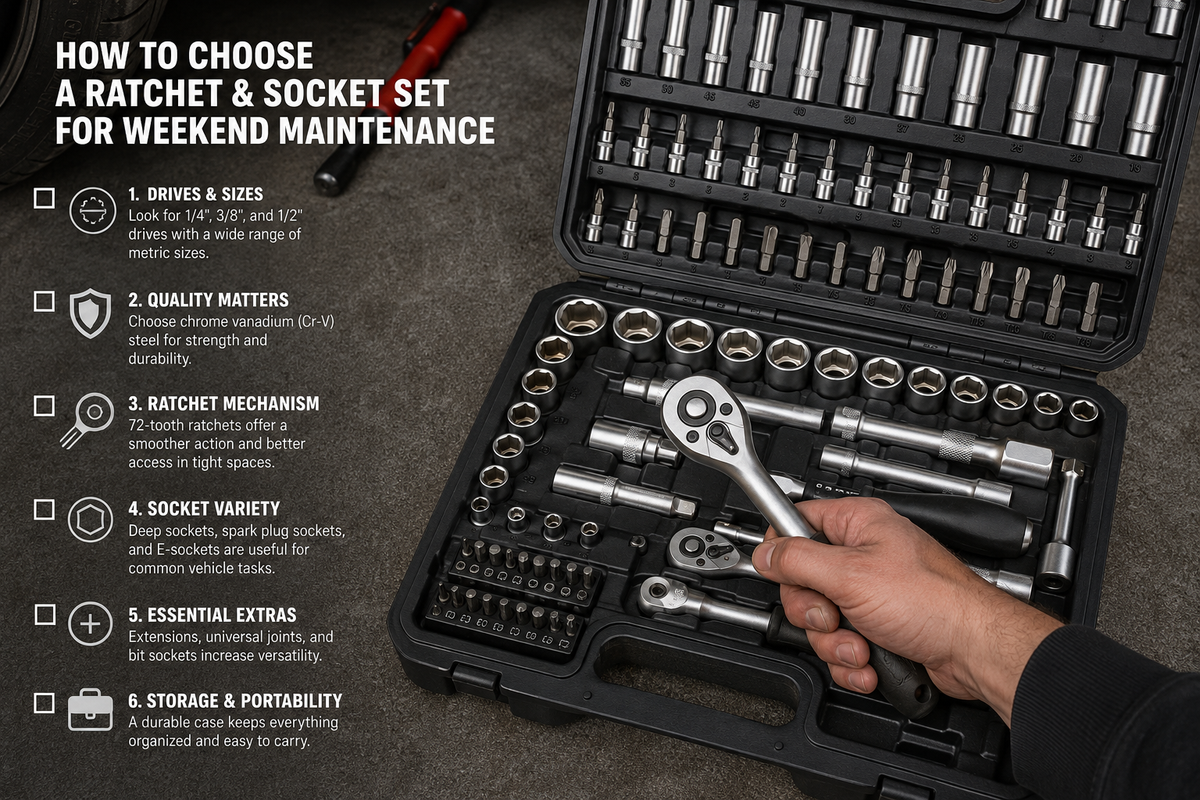
For weekend maintenance — car checks, bike repairs, fence gates, kettles of jobs around the home — the right ratchet and socket set saves time and stops you buying bits you won’t use. A good set gives variety in drive sizes and sockets, secure sockets that don’t round fasteners, and a tidy case you can take to the garage.
Key things to consider
- Drive sizes included (1/4", 3/8", 1/2") and when to use them
- Metric vs imperial sockets — what your projects use
- Socket types: shallow vs deep, 6-point vs 12-point
- Build quality, markings and finish for longevity
- Storage and portability (carry case, organisation trays)
- Extras: screwdriver bits, extensions, universal joints
Drive sizes explained
Most general-purpose sets include 1/4", 3/8" and 1/2" drives. Each has strengths for certain tasks:
| Drive | Typical bolts/nuts | Weekend tasks | Strengths |
|---|---|---|---|
| 1/4" | Small bolts, M4–M8 equivalent | Electrics, small appliances, bike tune-ups, brackets | Compact, good for tight spaces and light work |
| 3/8" | Medium fasteners, M8–M14 | Most car jobs (interior, some engine bolts), general maintenance | Most versatile for general DIY and garage work |
| 1/2" | Large bolts, bigger wheel nuts, heavy-duty fixings | Wheel nuts, suspension work, heavy-duty fence and gate fixings | Higher torque capability — for tougher fastenings |
Metric or imperial?
Check the fasteners you most often work with. Modern cars and many bikes from Europe use metric. Older UK or imported equipment and some plumbing fittings may use imperial (Whitworth or AF). If you work on a variety of items, look for sets that include both metric and imperial sockets, or buy metric first and add imperial sockets only if you need them.
Socket types and patterns
- Shallow sockets: Good for most nuts and bolts where the stud isn’t long.
- Deep sockets: Reach over long studs or to nuts on threaded rods.
- 6-point sockets: Best for hexagonal fasteners — less likely to round a nut.
- 12-point sockets: Easier to fit in tight spaces where you have limited swing, but can be slightly more prone to rounding soft fasteners when very high torque is used.
What to look for in build and finish
- Clear, laser-etched or stamped size markings so sockets are easy to find.
- Chrome or satin finishes resist corrosion and wipe clean; consider how the finish affects grip when oily.
- Good ratchet teeth count — more teeth (fine-tooth) means smaller swing arc and easier work in tight spaces.
- Secure socket retention (ball detent or friction ring) so sockets don’t fall off under load.
What a practical weekend set looks like
A versatile weekend set commonly includes:
- 1/4", 3/8" and 1/2" ratchets
- Shallow and deep sockets in common metric sizes (and some imperial if needed)
- Common screwdriver bits and bit adapter
- Extensions and a universal joint for awkward angles
- A sturdy carry case that keeps pieces organised
For example, the IRONVOLT 218-Piece Metric Socket and Ratchet Set includes 1/4", 3/8" and 1/2" drives, a range of sockets, bits and a carry case — a format that suits most weekend maintenance tasks. The IRONVOLT Tool Set is another compact option if you want a basic starter kit for general DIY jobs.
Matching drive sizes to common weekend tasks
- Small repairs and electronics — 1/4" drive and small metric sockets.
- General car maintenance — 3/8" drive handles interior jobs, brake components and many engine fastenings.
- Wheel nuts, suspension and larger bolts — 1/2" drive or an impact tool (if you have one) with suitable sockets.
Care, safety and best practice
- Always use the correct size socket — rounding nuts is often caused by the wrong size or poor engagement.
- Avoid using a cheater bar on a ratchet. If a fastener is stubborn, use a breaker bar sized for the job or apply penetrating oil and give it time.
- Inspect sockets and ratchets for cracks or worn teeth before use. Replace damaged tools — they can fail under load.
- Keep the ratchet mechanism clean and occasionally give it a drop of light oil to maintain a smooth action.
- For torque-critical fastenings (wheel nuts, head bolts), use a calibrated torque wrench rather than relying on feel.
Storage and organisation
Choose a set with a case or tray that keeps sockets sorted by size and drive. A neat layout saves time and reduces the chance of leaving pieces on the job. If you carry tools to jobs, choose a robust carry case or tool bag.
Recommendations (what to look for in an IRONVOLT set)
- Multiple drive sizes (1/4", 3/8", 1/2") so you’re prepared for light and heavier jobs.
- A good spread of socket sizes in metric (and some imperial if you expect to need them).
- Includes common extras: screwdriver bits, extensions, universal joints and adapters.
- Compact, well-organised carry case for portability and storage.
If you’d like a single practical kit to cover most weekend tasks, see the IRONVOLT 218-Piece Metric Socket and Ratchet Set — it bundles 1/4", 3/8" and 1/2" drives, a selection of sockets and a carry case. Browse the full range at IRONVOLT to pick the size and format that suits your workshop or garage.
FAQ
Do I really need all three drive sizes?
Not always. If your work is mostly small appliances and bikes, a 1/4" and 3/8" set might be enough. If you plan to do wheel or suspension work, a 1/2" drive is important. A combined set covers most needs without buying multiple separate kits.
Should I choose 6-point or 12-point sockets?
6-point sockets are typically better for stubborn hex fasteners because they contact the flats; 12-point sockets are handy in tighter spaces where you need more engagement angles. For general use, having a mix is useful.
Can I use socket adapters to save buying multiple drive sizes?
Yes — adapters let you use different drive sizes together. They’re handy, but adapters can change leverage and fit. For frequent heavy work, dedicated ratchets for each drive size are preferable.
How should I maintain my ratchets?
Keep them clean and free of grit, wipe off oil and grime after use, and apply a drop of light oil to the mechanism now and then. Store in a dry case to avoid corrosion.
Is the IRONVOLT 218-Piece set suitable for home mechanics?
The 218-piece set includes a broad range of sockets and drives suitable for many home and garage tasks. If you have specific heavy tasks (like commercial vehicle work), you may need specialist or higher-capacity tools in addition.
Final checklist before you buy
- Does it include the drive sizes and socket depths you need?
- Are metric and/or imperial sizes covered for your projects?
- Does the set include useful extras like extensions, bits and adapters?
- Is the case robust and well organised?
- Are sizes clearly marked and easy to read?
Choosing the right ratchet and socket set makes most weekend maintenance quicker and less frustrating. For a versatile, ready-to-go option, take a look at the IRONVOLT 218-Piece Metric Socket and Ratchet Set and the IRONVOLT Tool Set at IRONVOLT. If you’d like help picking the right combination for your projects, drop us a message through the IRONVOLT site.